Why Grip Socks Behave Differently at the End of Summer
Quick Answer: Grip socks lose performance at the end of summer for reasons that mostly have nothing to do with the socks. Feet swell in heat, which stretches the sock and moves the grip pattern off the contact points. Studio floors accumulate a summer of body oil, product residue and humidity, reducing the friction available. And the silicone grip itself degrades with heat, washing and fabric softener - a sock bought in May and worn through a hot summer has genuinely less grip than a new one. The fix is one honest assessment: check the sock, then check the floor, then check the fit.
They were fine in June. Now your foot is sliding on the reformer footbar and you are gripping with your toes to compensate.
Before you buy new ones, it is worth knowing which of three separate things is actually causing it, because two of them are free to fix.

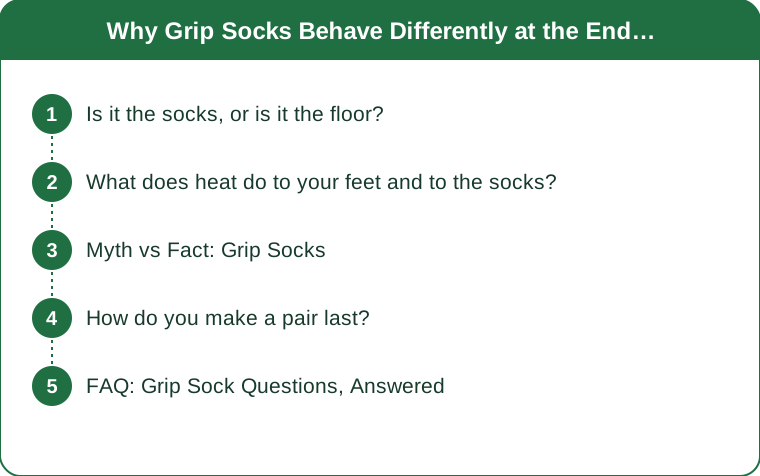
Is it the socks, or is it the floor?
Test it in thirty seconds before you spend anything.
Stand on a different surface in the studio - a mat, a different machine, a section of floor away from the main traffic area - and do the same movement. If the grip returns, the problem is the surface, not the sock.
Studio floors and equipment accumulate a film through the summer. Body oil, sunscreen residue, lotion and sweat all transfer onto surfaces, and equipment that is wiped with a spray that leaves any residue builds up a layer over months. Late August is the peak of that accumulation because it has been building since the season started.
Sunscreen is the underrated culprit. It is designed to spread and adhere, and in summer it is on nearly every client’s skin. Transferred onto a footbar, it creates exactly the low-friction film that grip socks cannot overcome.
If it is the surface, the fix is a proper clean rather than a wipe - an alcohol-based cleaner rather than a general disinfectant spray, which cuts the oil film that disinfectant leaves behind or does not touch.
It is worth mentioning to the studio rather than assuming it is you. If several people are slipping in the same weeks, it is the floor, and studios generally want to know.
What does heat do to your feet and to the socks?
Feet swell measurably in heat, and swollen feet change how the grip pattern sits.
Foot volume increases in hot weather through vasodilation and fluid pooling, and the effect is larger later in the day and after standing. A sock that fit correctly in a 65F May studio can be stretched taut in an 85F August one.
When the sock stretches, the silicone grip pattern spreads apart and moves off the contact points - the ball of the foot, the heel, the outer edge. The grip dots are still there, but they are no longer where the load is. This is why a sock can look completely fine and still slip.
The socks themselves also degrade with heat. Silicone grip is applied as a printed layer and it is vulnerable to high dryer heat, which softens and flattens the pattern permanently. A summer of hot washing and hot drying does more damage than a year of wear.
Fabric softener is worse. It coats fibers with a lubricating film by design, and that film transfers to and around the grip pattern. One wash with softener can measurably reduce grip, and the effect is cumulative.
And there is simple wear. The grip pattern abrades with use, and a sock worn twice a week since spring has been through enough cycles to show it. Look at the pattern under good light - flattened, shiny or missing dots at the ball and heel means the sock is done, regardless of how the rest of it looks.

Myth vs Fact: Grip Socks
Myth: More grip dots means more grip. Fact: Coverage matters less than placement and compound. A sock with well-placed grip at the ball, heel and outer edge outperforms one with full-sole coverage in a softer compound. Full coverage also tends to be less breathable and to slide more once it is wet, because there is nowhere for moisture to go.
Myth: You can restore grip by washing them. Fact: Washing removes surface contamination, which helps if the loss is from oil or softener buildup - so it is worth one honest attempt with hot water and no softener. But it cannot restore a flattened or abraded pattern. If a proper wash does not fix it, the sock is worn out.
Myth: Grip socks are mainly hygiene. Fact: They started as hygiene and are now genuinely functional. The grip changes what your foot can do - it allows loading through the outer edge and the ball without the foot sliding, which changes how the whole leg organizes. This is why slipping is not a minor annoyance; it changes the exercise.
Myth: Any grip sock works on any surface. Fact: Silicone grips differently on wood, vinyl, rubber and the covered surfaces of reformer equipment. A sock that grips beautifully on a mat can be poor on a footbar, and this is worth testing rather than assuming.
How do you make a pair last?
Four habits, and the first two do most of the work.
Never use fabric softener, and never use a dryer sheet in the same load. This is the single highest-impact rule. The lubricating film is the point of the product and it is exactly what you do not want near a grip pattern.
Air dry, always. Dryer heat flattens silicone permanently. Air drying costs you nothing and roughly doubles the useful life of a pair.
Wash inside out on a warm cycle. Inside out protects the grip from abrasion against the drum and against other garments, and warm water is enough to remove body oil - which is the main thing you are washing out.
Rotate at least three pairs. Grip patterns recover slightly between wears, and rotation spreads the abrasion. Three pairs last considerably more than three times as long as one pair does.
And size for the studio, not for the street. Grip socks should be snug enough that the pattern does not shift under the foot. If you are between sizes and train in a warm studio, size for the warm, swollen foot rather than the morning one - a sock that is slightly loose is far less of a problem than one stretched taut with the pattern displaced.
Realistic replacement timing for two-to-three sessions a week with good care is six to nine months. Sooner if you have been drying them hot, and much sooner if softener has been involved.

FAQ: Grip Sock Questions, Answered
How do I know when they are actually worn out?
Look at the pattern in direct light. New silicone is matte and slightly raised, with defined edges. Worn silicone is shiny, flattened, and often missing entirely at the ball of the foot and the heel. If the high-load areas are shiny and flat, the sock is finished even if it looks fine otherwise.
Why do they grip well on the mat but not on the reformer?
Different surfaces, different friction. Reformer footbars and carriages are typically covered in a smooth vinyl or coated material that has much less inherent texture than a rubber mat, and they collect body oil from every previous user. The sock is not failing - it is being asked for more.
Should I buy full-sole or partial coverage?
Partial coverage with grip at the ball, heel and outer edge is generally the better choice for reformer and mat work - it is more breathable, and grip placed where the load is does more than grip everywhere. Full sole is more useful on very smooth surfaces or for people who slide laterally.
TL;DR:
- Test the floor first - if grip returns on a different surface, the socks are fine and the equipment needs cleaning.
- Summer floors accumulate sunscreen, lotion and body oil, which no sock can overcome.
- Feet swell in heat, stretching the sock and moving the grip pattern off the load points.
- Fabric softener and dryer heat destroy silicone grip faster than wear does.
- Air dry, wash inside out, rotate three pairs, and size for the warm foot.
- Shiny, flat grip at the ball and heel means the pair is finished - six to nine months is normal.
Most late-summer slipping is a floor problem or a laundry problem, and both are cheaper to fix than a new pair.
Keep Reading
This article is for general informational and styling purposes only. Fit, sizing, and product availability may vary.