Why Your Grip Socks Slide on a Newly Cleaned Studio Floor
Quick Answer: Silicone grip works by making direct contact with the floor. Floor polish, residual detergent film, dust and gym-floor conditioner all sit between the two and eliminate that contact — which is why your socks feel dead on a freshly cleaned floor and fine the next week. Wash your socks in hot water without fabric softener, and if the problem follows the floor rather than the socks, it is not the socks.
You have worn the same pair for three months. On Tuesday they gripped. On Thursday, on a floor that smells faintly of cleaning product, you slide out of a lunge.
The socks did not change in two days. Something got between them and the floor.
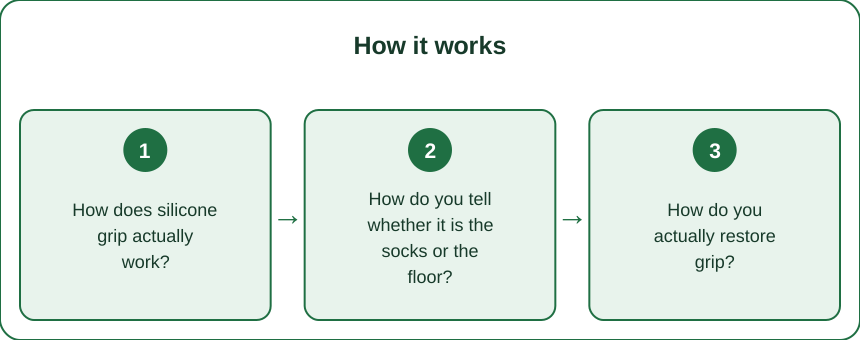
How does silicone grip actually work?
Not by friction in the everyday sense — by conformity and adhesion.
The silicone dots or pattern on the sole are a soft elastomer. Under your body weight they deform slightly and flow into the microscopic texture of the floor, creating a large area of genuine contact. That intimate contact is what produces the very high coefficient of friction silicone is known for. It is closer to how a gecko’s foot works than to how a rubber block on sandpaper works.
Everything that follows comes from that one fact: anything that prevents direct silicone-to-floor contact removes the grip almost entirely. Not reduces — removes. A film only a few microns thick is enough, because the mechanism depends on contact at that scale.
The three things that get in the way, in order of how often they are the culprit:
Floor treatment. Polish, wax, and gym-floor conditioners are designed to leave a smooth protective layer. That layer is exactly what silicone cannot key into. A studio that has just had its floors done is the single most common cause of a sudden grip failure across a whole class.
Detergent residue on the floor. A floor mopped with too much product, or not rinsed, leaves a slightly soapy film that is invisible and extremely slippery under silicone.
Fabric softener on the socks. This is the sock-side equivalent and it is the most common user error. Softener deposits a waxy cationic coating over everything in the drum, silicone included, and it is remarkably persistent.
How do you tell whether it is the socks or the floor?
A two-minute diagnostic that saves you buying socks you do not need.
Test the same socks on a different surface. A tiled kitchen floor, a wooden floor at home. If they grip there and not at the studio, the floor is the variable and no amount of new socks will help.
Ask whether anyone else is sliding. If it is the floor, it is affecting the whole class. If it is only you, look at your socks and your washing routine.
Look at the silicone under good light. Working silicone is matte and slightly tacky to a fingertip. Failed silicone is shiny, slick, or visibly worn flat. A shiny silicone dot that still looks intact is a coated dot, not a worn one — and coating can usually be removed.
Check the age and wash count. Silicone printing genuinely wears out, typically after somewhere between 50 and 100 washes depending on quality and drying method. If the dots are visibly thin, cracked or partly missing, the socks are simply finished.
And check whether the problem started the same week the studio was cleaned or refurbished. This correlation is very strong and very often overlooked.
How do you actually restore grip?
If the diagnosis points at the socks, most of the time they are recoverable.
Wash hot, without fabric softener. 40–60°C, normal detergent, no softener, no dryer sheets. Two or three cycles will strip most accumulated softener build-up. This alone fixes the majority of “my grip socks stopped working” cases.
Add a cup of white vinegar to the rinse for one wash. It helps break down cationic softener residue and mineral deposits from hard water. Do not mix it with detergent in the same phase — the rinse cycle is the right place.
Skip the tumble dryer. Heat is what degrades silicone printing over time — it makes it brittle and it can cause it to lift at the edges. Air drying roughly doubles the useful life of a pair. If you must tumble, use the coolest setting.
Turn them inside out to wash. Reduces abrasion on the printed side against the drum and other garments.
And wipe them before class if the floor is suspect. A quick wipe of the soles with a damp cloth or an alcohol wipe removes surface dust and any transferred floor product. It takes ten seconds and it works surprisingly well.
If the floor is the problem, the honest answer is that it is the studio’s to solve — but socks with a denser, full-coverage silicone pattern rather than scattered dots perform noticeably better on treated floors, because the total contact area is larger.
What nobody tells you about grip socks
Full-sole coverage beats dot patterns on bad floors, and loses on good ones. Dense coverage gives you contact area when contact is compromised. On a clean, untreated floor, dot patterns are often grippier per unit of material and considerably more breathable. If you train on one floor, buy for that floor.
Grip on the toes matters more than grip on the heel for most Pilates and barre work, because that is where the load goes in a plank, a lunge or a footbar position. A sock with a bare toe box is a sock designed for something else.
They stop being hygiene equipment and start being safety equipment above a certain level. In reformer work particularly, a foot slipping off a footbar under spring load is a genuine injury risk rather than an inconvenience. This is why studios mandate them, and it is why a pair that has gone shiny should be retired rather than nursed along.
Sizing changes grip. A sock that is too big lets the sole rotate relative to your foot — the silicone stays put and your foot moves inside it, which feels exactly like a grip failure and is not one. This is a very common problem in socks bought in a size range rather than a size.
And new socks are often slightly slippery for the first wear, from mould release residue on freshly printed silicone. One wash before first use solves it, and a surprising number of “these are faulty” experiences are just that.
FAQ: Grip Sock Questions, Answered
How long should a pair of grip socks last?
Roughly 50–100 washes for decent quality, considerably less if you tumble dry them. Judge by the silicone rather than the fabric — the sock usually outlasts the grip, and a sock with worn grip is just a sock.
Can I use fabric softener if I really like it?
Not on grip socks. Softener leaves a waxy coating on the silicone that is the single most common cause of grip loss, and it takes several hot washes to remove. Keep them out of any load where softener is used.
Should I tell the studio if the floor is slippery?
Yes, and specifically rather than generally — mention when it started and whether a whole class was affected. Over-application of floor product or an unrinsed mop is a fixable problem and a genuine safety issue, and studios usually want to know.
Do more expensive grip socks actually grip better?
Sometimes, and mostly through coverage and print quality rather than a better material — it is nearly always the same silicone. Pattern density, print thickness and how well the sock fits your foot matter more than the price does.
TL;DR:
- Silicone grips by conforming to the floor at a microscopic scale, so any film between the two removes the grip almost completely.
- Floor polish, detergent residue and fabric softener are the three usual suspects, in that order.
- Diagnose by testing on another surface and by asking whether anyone else is sliding.
- Wash hot with no softener, add vinegar to one rinse, and never tumble dry.
- Shiny silicone that looks intact is usually coated rather than worn — and coating comes off.
Before you buy a new pair, run two hot washes and check whether the studio has just had its floors done.
Keep Reading
This article is for general informational and styling purposes only. Fit, sizing, and product availability may vary.