Do Grip Socks With Arch Support Actually Do Anything?
Quick Answer: The arch band on grip socks is a compression band, not structural support. It cannot hold up an arch the way an orthotic does, but compression around the midfoot does provide proprioceptive feedback and a secure fit that stops the sock rotating — and a sock that does not rotate keeps the grip dots where they belong. That fit benefit is real and is most of what you are paying for.
The marketing implies orthotic function. The actual benefit is sock stability, which matters more than it sounds.

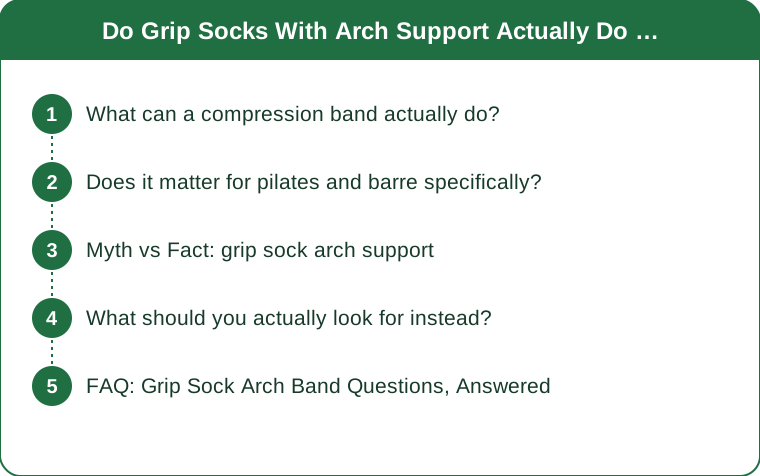
What can a compression band actually do?
Three things, only one of which is what the packaging implies.
It holds the sock in position. This is the genuine, measurable benefit. Grip socks work because rubber dots sit under the ball of the foot and heel. If the sock rotates during class, those dots move off the contact points and the sock becomes a regular slippery sock with decorative rubber on the side. A midfoot band anchors it.
It provides proprioceptive feedback. Compression against the skin increases sensory input from the area, which some people experience as improved awareness of foot position. This is a real phenomenon and it is also why compression garments feel supportive without changing joint mechanics.
What it cannot do: physically support the arch. The arch of the foot is held by the plantar fascia, the intrinsic foot muscles and the ligaments. A band of elasticated fabric applies a few millimeters of circumferential compression — nowhere near the force required to alter arch height under body weight. Anyone telling you a sock replaces an orthotic is describing something the material cannot do.
The honest framing: it is a fit feature that also feels nice, not a therapeutic device.
Does it matter for pilates and barre specifically?
Yes, because these are the activities where sock rotation is most likely and most consequential.
Reformer work loads the foot at an angle. Pressing into a footbar with the foot flexed applies shear force across the sole — exactly the force that rotates an unanchored sock. This is why reformer users notice the difference from a band more than yoga users do.
Barre involves a lot of rising and lowering on the ball of the foot. Repetitive plantarflexion under load slides a loose sock forward, bunching fabric at the toes and pulling the heel dot off the heel.
Lateral movement is the worst case. Anything with side-to-side work — some barre sequences, functional classes — puts the highest rotational force on a sock.
Where it matters least: static yoga, where the foot is mostly planted and the sock is not being asked to resist shear.
One thing worth noting: a well-fitted sock in the correct size rotates far less than an oversized one regardless of whether it has a band. The band compensates for imperfect sizing. Getting the size right is the more fundamental fix.

Myth vs Fact: grip sock arch support
Myth: Arch support socks help plantar fasciitis.
Fact: Compression can reduce the sensation of discomfort for some people, and there is reasonable evidence that compression sleeves provide symptomatic relief for various soft-tissue complaints. That is symptom management, not correction, and it is not a substitute for a proper assessment if you have persistent heel pain. This is general information, not medical advice.
Myth: The band prevents overpronation.
Fact: Pronation is a motion of the subtalar joint under load. Fabric compression around the midfoot does not meaningfully alter it. Footwear and orthotics can; socks do not.
Myth: More compression is better.
Fact: Excessive midfoot compression restricts the natural splay of the foot during weight-bearing, which is the opposite of what you want in barefoot-style training. A band tight enough to leave a deep mark after class is too tight.
Myth: You need the band or the socks will slip.
Fact: Correct sizing does most of that job. The band is insurance, not the mechanism.
What should you actually look for instead?
Five features that affect performance more than the arch band does.
1. Grip dot coverage and placement. Full-sole coverage beats scattered dots, and coverage at the outer edge of the forefoot matters for lateral stability. Check that the dots extend to where your foot actually contacts, not just the center.
2. Dot material quality. Silicone dots outlast printed rubber compounds by a wide margin. Cheap printed grip cracks and flakes within a few dozen washes, which is the real cause of grip socks “losing grip.”
3. Toe seam position. A seam sitting directly across the toes is the most common source of grip sock irritation and blisters. Seamless or well-placed toe construction matters more for comfort than anything else on this list.
4. Fiber content. Cotton holds moisture and gets slippery inside; a blend with a moisture-moving synthetic and some elastane performs better in a warm studio.
5. Heel cup shape. A shaped heel keeps the heel dot on the heel. A tube-shaped sock with no heel shaping will rotate no matter what the arch band does.
FAQ: Grip Sock Arch Band Questions, Answered
If I have flat feet, are these worth it?
For sock stability, yes — same as for anyone. For arch correction, no. If flat feet cause you pain during training, that is a conversation for a physiotherapist or podiatrist, and footwear and strengthening will do far more than a sock.
Should the band leave a mark on my foot?
A light temporary impression is normal. A deep indentation that lasts more than a few minutes, or any numbness or tingling, means the sock is too tight or too small. Size up.
Do they wash differently from regular grip socks?
Same rules, and they matter for both: cold or warm wash, inside out, no fabric softener, and never in the tumble dryer. Heat is what destroys both the grip dots and the elastane in the band. Fabric softener coats the silicone and is the single fastest way to ruin a pair.
TL;DR:
- The arch band is compression, not structural support — it cannot hold an arch the way an orthotic does.
- Its real benefit is keeping the sock from rotating, which keeps the grip dots on the contact points.
- It matters most for reformer and barre, least for static yoga.
- Correct sizing does more for stability than the band does.
- Prioritize dot coverage, silicone quality, toe seam position, fiber content and heel shaping instead.
The band is a good feature sold with the wrong story. Buy it for the fit, not for the arch.
Keep Reading
This article is for general informational and styling purposes only. Fit, sizing, and product availability may vary.