Why Grip Socks Feel Different in a Cold Studio
Quick Answer: Silicone grip loses tack as temperature drops, and a cold studio floor or reformer surface can be several degrees below air temperature. Add cold feet that are less sensitive and slightly shrunken inside the sock, and grip that felt secure in August genuinely does not in October. Warming your feet before class and choosing thicker, denser grip patterns solves most of it.
The common wrong conclusion is that the socks wore out. Test them on a warm surface before replacing them.

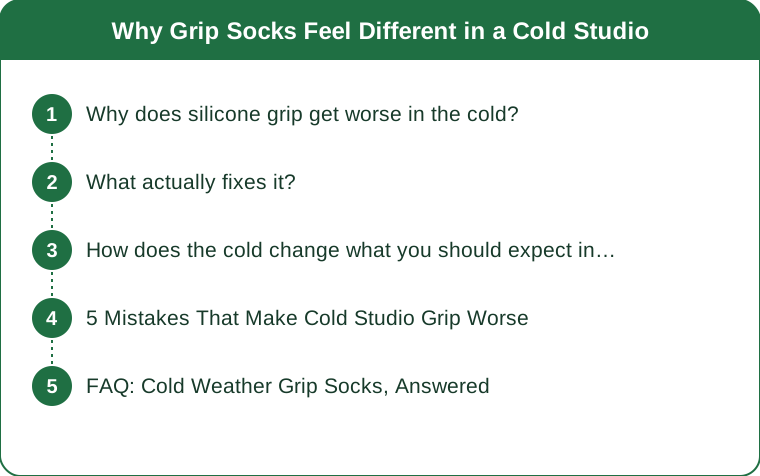
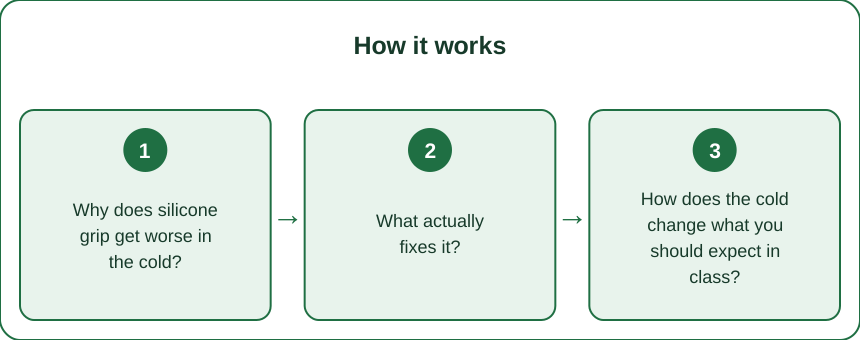
Why does silicone grip get worse in the cold?
Because the material itself changes properties, and so does the surface it is gripping.
What happens to silicone in cold. Silicone becomes firmer and less tacky as temperature falls. The grip relies on the material deforming slightly to increase contact area with the surface. A firmer material deforms less and grips less - the effect is modest between 20C and 15C, and noticeable by 10C.
What happens to the surface. A studio floor or reformer carriage can be several degrees below air temperature, particularly in the morning, and particularly if the studio has been unheated overnight. Wood, vinyl, and metal all equilibrate with the room slowly, so the first class of a cold day is on the coldest surface of the day.
What happens to your feet:
- Reduced circulation means cooler feet with slightly reduced volume, so the sock fits marginally looser and the grip pattern can shift under load rather than staying put
- Reduced tactile sensitivity means you feel the slip later and correct later
- Cold feet grip less well with the toes, and toe engagement contributes more to stability than people realise
The condensation factor. A warm foot inside a sock against a cold surface creates a small amount of moisture at the interface. Moisture between silicone and a smooth surface reduces friction sharply - this is the same mechanism that makes a cold pole slippery.
How to tell this from worn-out socks. Warm the socks - hold them against a radiator or between your hands for a minute - and test again on the same surface. If grip returns, it is temperature. If it does not, the silicone has genuinely degraded, which typically happens after 50 to 80 washes or from washing too hot.
What actually fixes it?
Warm feet, warm surface, and a grip pattern suited to the conditions.
Warming your feet, which is the highest-impact and most-skipped step:
- Arrive with warm socks on over the grip socks, and remove them at the start of class
- Do 30 seconds of ankle circles, toe curls, and calf raises before stepping onto equipment. This drives blood into the feet faster than anything passive
- Wear proper shoes to the studio. Arriving in sandals in October means starting class with cold feet
- Rub your feet with your hands if all else fails - crude and effective
Warming the surface:
- Wipe down the reformer carriage or mat with a cloth, which removes any condensation film
- Stand on the mat for a minute before starting, which warms the contact area
- The first few repetitions are surface warming, so treat them accordingly rather than going straight to a demanding movement
Choosing socks for cold conditions:
- Denser, more numerous grip dots outperform sparse large patches when tack is reduced. More contact points means more total friction
- Full-sole silicone coverage rather than dotted, if the studio surface is smooth
- A thicker sock body keeps feet warmer, which addresses the cause rather than the symptom. Thin summer grip socks are part of the problem in a cold studio
- A snug fit matters more now, since a loose sock lets the grip pattern move independently of your foot
Maintenance that preserves grip, which people get wrong all year:
- Wash cold or warm, never hot. Heat degrades silicone permanently and is the single biggest cause of premature grip loss
- Never tumble dry. Air dry flat or hanging
- Turn inside out to protect the grip surface in the wash
- No fabric softener. It leaves a film on the silicone that reduces grip and does not fully wash out
- Wash after every use, since sweat and skin oils build up on silicone and reduce tack
The test for whether they are actually finished. Look at the silicone under good light. Grip that has genuinely degraded looks cracked, thinned, or partly detached. Grip that just feels bad in a cold room looks perfectly intact.

How does the cold change what you should expect in class?
Slightly more caution early, and a longer warm-up than the studio might schedule.
Where slipping actually causes problems:
- Standing work on the reformer - the highest-consequence place for a foot to slip
- Any movement with the feet in straps or on the footbar under load
- Single-leg standing balance work on a mat
- Lunges and split positions, where the rear foot slides most easily
Practical adjustments for the first cold weeks:
- Ask for a slightly longer warm-up or arrive early and do your own. Studios often run the same warm-up year-round regardless of temperature
- Reduce load or spring tension slightly on standing work until you are confident in the grip
- Check your foot position more deliberately rather than relying on feel, since tactile sensitivity is reduced
- Speak up if the studio is genuinely cold. Most studios will adjust heating if asked, and if one person is cold, everyone is
The equipment side, which is the studio’s job but worth knowing:
- Reformer carriages should be wiped between users for hygiene and it also removes any moisture film
- A worn reformer surface grips differently from a new one, and this is more noticeable when tack is reduced
- If one machine consistently slips more, mention it - it may need cleaning or resurfacing rather than being your fault
On the hygiene point that becomes more relevant in cold months. Feet sweat inside thicker socks in a warm studio, and wearing the same grip socks for multiple classes without washing degrades grip and is genuinely unpleasant. Silicone holds oils. Rotate two or three pairs so each gets washed properly between uses.
When to actually replace them. Typical life is 50 to 80 washes with correct care, considerably less with hot washing or tumble drying. Replace when the silicone is visibly cracked, thinned, or lifting - not because they felt slippery on the coldest morning of the year.
5 Mistakes That Make Cold Studio Grip Worse
1. Replacing socks that are only cold. Warm them between your hands for a minute and retest before buying new ones. Grip that returns with warmth was never worn out - and this mistake is expensive to repeat every autumn.
2. Arriving with cold feet and starting immediately. Thirty seconds of ankle circles, toe curls, and calf raises drives blood into the feet and restores most of the sensitivity and grip you are missing. It is the cheapest fix available and almost nobody does it.
3. Wearing thin summer grip socks in a cold studio. A thin sock keeps feet cold, and cold feet are the underlying cause. A thicker sock body addresses the problem rather than the symptom.
4. Using fabric softener. It leaves a film on silicone that reduces grip and does not wash out properly. This is the most common permanent grip-killer and people do it for years without connecting the two.
5. Hot washing or tumble drying. Heat degrades silicone permanently and irreversibly. Cold or warm wash, air dry, inside out roughly doubles the working life of a pair. A tumble dryer can ruin them in a handful of cycles.
Three of these are about care rather than cold, and they matter more in winter because you have less grip margin to spare.
FAQ: Cold Weather Grip Socks, Answered
Why are my grip socks slipping now when they were fine in summer?
Silicone becomes firmer and less tacky as temperature drops, cold studio surfaces are often below air temperature, and cold feet are less sensitive and slightly shrunken in the sock. All three reduce grip at once.
How do I tell if my grip socks are worn out or just cold?
Warm them between your hands for a minute and test on the same surface. If grip returns, it was temperature. Genuinely degraded silicone looks cracked, thinned, or lifting under good light.
What grip pattern works best in a cold studio?
Denser, more numerous dots or full-sole coverage rather than sparse patches. More contact points compensate for reduced tack per point. A thicker sock body also keeps feet warmer, which addresses the cause.
How long should grip socks last?
Roughly 50 to 80 washes with correct care - cold or warm wash, no softener, no tumble drying, turned inside out. Hot washing or tumble drying can cut that dramatically.
Does fabric softener really matter?
Yes, considerably. It leaves a film on the silicone that reduces grip and does not fully wash out. It is probably the most common reason grip socks stop working before their time.
What can I do in the two minutes before class?
Ankle circles, toe curls, and calf raises for 30 seconds, wipe the reformer or mat with a cloth, and stand on the surface for a minute before starting. That covers warm feet and a warm surface, which is most of the problem.
TL;DR:
- Silicone loses tack as it cools, and studio surfaces are often colder than the air
- Cold feet are less sensitive and slightly shrunken, so the sock shifts under load
- Warm your feet for 30 seconds before class - ankle circles, toe curls, calf raises
- Choose denser grip patterns and thicker sock bodies for the cold months
- Never use fabric softener, hot water, or a tumble dryer - all three destroy silicone permanently
Before buying replacements, warm the pair you have and test them again. Most autumn grip complaints are a cold room, not a worn sock.
Keep Reading
This article is for general informational and styling purposes only. Fit, sizing, and product availability may vary.