Why Grip Socks Give You Toe Blisters Nobody Warned You About
Quick Answer: Toe blisters from grip socks usually come from a bulky or misaligned toe seam rubbing repeatedly during class movement, not from the grip dots themselves. Look for seamless-toe construction or socks with a flat, low-profile toe closure to eliminate the friction point entirely.
You expected grip socks to solve your slipping problem in barre or Pilates — and they did — but now you’ve got a new, more annoying issue: a blister forming right at the seam across your toes.

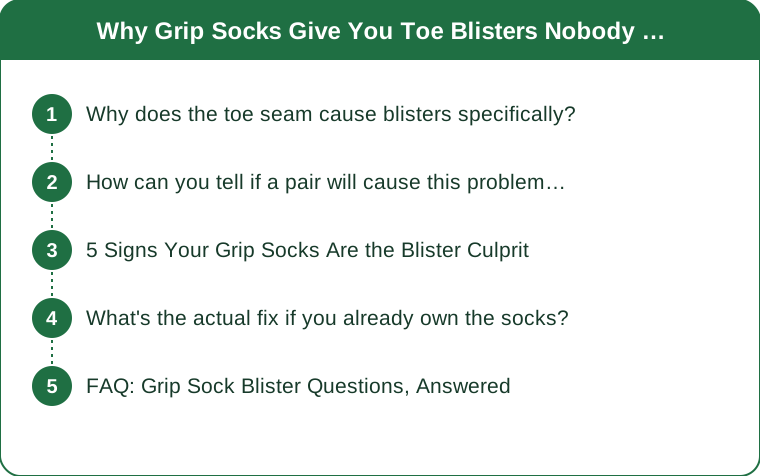
Why does the toe seam cause blisters specifically?
Most sock manufacturing uses a seam to close the toe area, and in cheaper or poorly constructed socks, this seam sits as a raised ridge directly across the top of your toes — a spot that gets repeated friction every time your foot flexes or points during class.
Grip sock fabric is often slightly thicker than regular sock fabric to hold the silicone dots securely, which can make a bulky toe seam even more pronounced than in a standard thin sock.
How can you tell if a pair will cause this problem before wearing them out?
Turn the sock inside out and run a finger across the toe seam — if you can clearly feel a raised, hard ridge rather than a flat, smooth line, that’s a blister risk under repeated movement.
Seamless-toe construction, now common in many athletic sock lines, eliminates this ridge entirely by knitting the toe closed without a traditional seam — worth specifically searching for if you’ve had blister issues before.

5 Signs Your Grip Socks Are the Blister Culprit
1. The blister forms in a straight line across multiple toes. That pattern specifically points to a seam, not general shoe or barefoot friction.
2. It only happens in grip socks, not regular workout shoes. Confirms the sock construction, not your foot mechanics, is the cause.
3. You can feel a ridge when you run a finger over the inside toe area. A direct, easy self-check.
4. The blister appears mid-class, not at the very start. Repeated flexing under moving friction is what develops it — a single static pose rarely causes this.
5. It happens more in certain shapes of movement (pointed toes) than others. Confirms friction concentration during specific foot positions.
What’s the actual fix if you already own the socks?
Try wearing them inside-out if the fit still works — this puts the seam ridge against the outside rather than directly against skin, a common quick fix while shopping for a better pair.
A thin layer of blister-prevention balm or tape directly over the toe seam area before class also reduces friction significantly as an interim solution.
FAQ: Grip Sock Blister Questions, Answered
Are all grip socks prone to toe blisters?
No — quality varies significantly by brand and construction. Seamless-toe designs specifically avoid this issue regardless of the grip dot pattern.
Does sock material affect blister risk beyond the seam?
Yes — moisture-wicking materials reduce friction from sweat buildup, which compounds seam-related rubbing; cotton-heavy blends tend to hold moisture and worsen the problem.
Should I size up to avoid toe seam rubbing?
Not usually the fix — a seam issue persists regardless of size, and sizing up can actually add bunching that makes friction worse rather than better.
TL;DR:
- Toe blisters from grip socks usually come from the toe seam, not the grip dots themselves
- Check for a raised ridge by turning the sock inside out and feeling across the toe area
- Seamless-toe construction eliminates this friction point entirely
- Wearing socks inside-out or using blister balm are quick fixes while you shop for a better pair
Next pair, run the inside-out finger test before you buy — it takes five seconds and prevents a blister you’d otherwise discover mid-class.
Keep Reading
This article is for general informational and styling purposes only. Fit, sizing, and product availability may vary.