How Long Grip Socks Last (and What Wears Them Out First)
Quick Answer: With two-to-three classes a week and decent care, a quality pair of grip socks lasts roughly six to twelve months - and it is almost always the grip that dies, not the sock. The killers, in order: dryer heat (hardens and cracks the dots), fabric softener (coats them slippery), and walking on rough surfaces (shears them off). Wash cold and gentle, air dry always, rotate three pairs, and retire a pair the day it slides on a floor you know.
Grip socks occupy a strange product category: the fabric can be pristine while the pair is functionally dead, because the sock and its grip age on completely different clocks. Once you know what actually wears out first, doubling their lifespan costs nothing but a laundry habit.

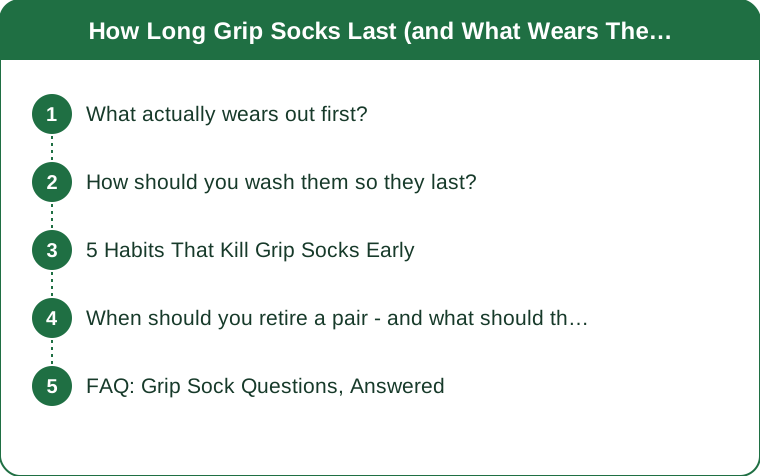
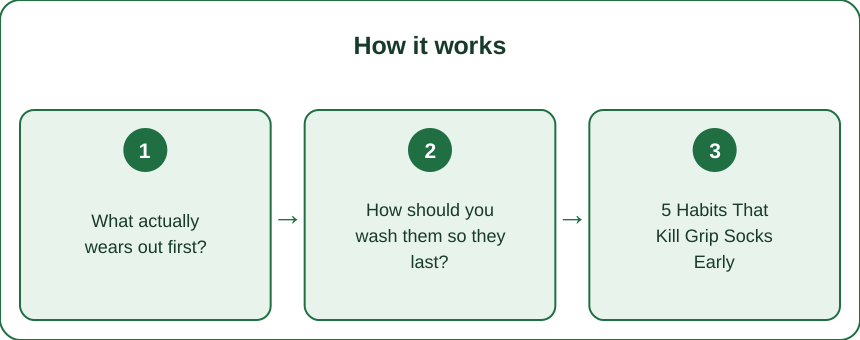
What actually wears out first?
There is a consistent order of death, and the toe hole everyone expects comes last.
First: the dots harden and glaze. The grip elements - usually silicone or PVC - stay tacky by staying slightly soft. Heat cycles age them the way sun ages a rubber band: they stiffen, glaze over, and finally crack. A hardened dot still looks intact while gripping like a plastic button, which is why worn pairs fool the eye and betray the foot.
Second: the dots shear off. Friction against concrete, asphalt, and rough studio lobbies peels grip elements away entirely - typically starting under the ball of the foot, exactly where a lunge or a reformer footplate loads hardest. A bald patch there is a functional failure even with ninety percent of dots surviving elsewhere.
Third: the coating film. Fabric softener and dryer sheets deposit a lubricating layer over everything they touch - which is their whole job, and the precise opposite of the sock’s. A pair can have soft, intact, fully-populated dots and still slide because every dot is wearing a coat of softener. This failure is invisible and completely self-inflicted.
Fourth: the elastic and knit. The cuff relaxes, the arch band loosens, the footbed thins. By the time the fabric genuinely fails, the grip has usually been dead for months.
The practical translation: judge a grip sock by its worst dot zone and its slide behavior, never by whether it has holes. The sock is the vehicle; the dots are the tires - and everyone replaces tires before the car.
How should you wash them so they last?
The entire care protocol is five rules, and the first one does half the work.
1. No dryer, ever. Tumble heat is the number one dot-killer - it hardens silicone, curls edges, and can soften adhesive-set grip elements enough to peel. Air drying costs twelve hours of patience and roughly doubles working life. If a rack is not an option, flat on a towel does the same job.
2. No fabric softener, no dryer sheets - and watch the detergent label. Anything that promises softness works by coating fibers with lubricant, and lubricated grip is not grip. Plain detergent only; the socks will not miss the softness.
3. Cold and gentle, dots out. Cold water is kinder to both elastic and grip. Wash them as they are worn - dots outward - so the grip surface is not grinding against its own fabric backing, and skip heavy-agitation cycles.
4. Use a mesh laundry bag. Loose in a drum with jeans and zippers, dots catch, snag, and peel. The two-dollar mesh bag is the highest-return accessory in the entire care routine, and it also stops the eternal single-sock disappearance.
5. Air them between classes and skip the radiator. Sweat-damp socks balled in a gym bag breed odor into the footbed, and drying them on a heater replays the dryer problem in slow motion. Draped over the bag handle at home overnight is all it takes.
And the meta-rule that beats all five: rotate three pairs. Grip compounds recover between wears, laundry stops being urgent, and each pair sees a third of the mileage. Three rotated pairs reliably outlast four pairs used one-at-a-time to death - the rare case where buying ahead is genuine economy.

5 Habits That Kill Grip Socks Early
1. Wearing them to and from the studio. Pavement, parking lots, and sidewalk grit belong to shoes. Fifty yards of asphalt does more shearing damage than a full week of reformer work - the dots were engineered for polished wood and machine surfaces, not aggregate. Socks go on at the studio door, and off at it.
2. The dryer, again, because it is that decisive. One accidental hot cycle ages a pair by months. Households where laundry gets pooled need the mesh-bag-plus-note system, because the person doing a generous load of towels is the pair’s greatest natural predator.
3. Kitchen duty at home. The same pair that does Tuesday pilates spends weekends gripping tile, hardwood grit, and door thresholds - all sandpaper to silicone. If sock-wearing at home is the culture, a retired pair takes house duty and the active pairs stay studio-only.
4. Bleach and stain-fighting enthusiasm. Oxidizers attack both elastane and grip compounds. A stained grip sock is a cosmetic issue; a bleached one is a structural one. Spot-treat with plain detergent and accept that studio socks live a visible life.
5. Buying one pair and marrying it. A single pair worn three times weekly takes every class, every wash, and zero recovery days - and dies in a season. This is the same mistake as running one pair of trainers into the ground, scaled down to sock money.
Bonus: choosing cute over coverage. Grip layouts vary wildly - some fashion-first pairs dot only the heel and ball, leaving the arch and toes bald. For reformer straps, standing splits, and single-leg work, full-sole coverage patterns are the difference between a sock and a decoration.
When should you retire a pair - and what should the replacement have?
A test, a checklist, and a two-minute buying guide.
The slide test is the retirement standard. On a floor you know - your usual studio spot, your kitchen tile - plant one foot and press into a controlled twist or lunge. Any slide that would not have happened at month one is the answer. Grip failure is progressive, so the pair that slips slightly today slips meaningfully in a month; the test just makes the trend visible early.
The visual audit backs it up: bald zones under the ball of the foot, dots that look glazed or feel hard to a fingernail, cracked or curling elements, or a cuff that no longer holds position. Two or more of those and the slide test is a formality.
Retired does not mean trash. Dead-grip socks are perfectly good cozy socks, travel slippers, and house-duty pairs - the demotion pipeline is the guilt-free version of replacement.
Replacement checklist, in priority order: full-sole grip coverage (not just heel and ball); a dot compound that feels slightly tacky rather than hard plastic; an arch band for stay-put fit; cushion level matched to your class (thin and close-fitting for reformer feel, cushioned for jump board and barre cardio); and a snug heel pocket, because a sock that rotates under the foot is a grip sock gripping the wrong spot.
Fit note that surprises people: grip socks should run snugger than everyday socks - loose fabric between foot and floor is its own slip layer, and no dot compound can fix a sock that moves. Between sizes, size down.
The studio-uniform logic applies head to toe: the same reasoning that made high-waisted leggings the reformer standard - nothing shifting mid-move - is why the sock must fit like it was painted on. Gear that stays put is gear you stop thinking about, which is the entire point.
FAQ: Grip Sock Questions, Answered
How often should grip socks be replaced?
At two-to-three classes a week with good care, expect six to twelve months per pair - less with dryer exposure or pavement wear, more with a three-pair rotation. The real answer is the slide test: the day a pair slips on a floor it used to hold, its studio career is over regardless of age.
Can you machine wash grip socks?
Yes - cold, gentle cycle, inside a mesh bag, with plain detergent. The prohibitions are the dryer (heat hardens and cracks the grip), fabric softener and dryer sheets (they coat the dots slippery), and bleach (attacks elastic and grip compounds). Air dry flat or on a rack, never on a radiator.
Why did my grip socks get slippery even though the dots look fine?
Almost certainly coating - fabric softener, dryer sheets, or a softening detergent deposited a lubricant film over the grip elements. A couple of cold washes in plain detergent, dots out, usually strips it and restores most of the tack. If they stay slick after that, the dots have likely heat-hardened, which is not reversible.
Are expensive grip socks worth it?
Usually the mid-tier is the value sweet spot: full-sole grip coverage, an arch band, and a quality dot compound are worth paying for; brand-name premiums beyond that mostly buy colorways. Whatever the price, care is the bigger variable - a rotated, air-dried budget pair outlives a boutique pair that rides the dryer.
TL;DR:
- The grip dies first, not the fabric: heat hardens dots, softener coats them, pavement shears them.
- Care protocol: cold gentle wash in a mesh bag, plain detergent, air dry, never the dryer.
- Socks live at the studio - pavement commutes and kitchen duty are the silent killers.
- Rotate three pairs; retire on the slide test, then demote to cozy-sock duty.
- Replacements need full-sole coverage, an arch band, and a snug fit - loose socks slip regardless of dots.
A grip sock is a set of tires wearing a sock costume. Treat the rubber right and the whole thing lasts a year - feed it to the dryer and it lasts a season.
Keep Reading
This article is for general informational and styling purposes only. Fit, sizing, and product availability may vary.