How Many Pairs of Grip Socks Do You Actually Need?
Quick Answer: The working formula is your weekly sessions plus two. Train twice a week, own four pairs. Train four times, own six. The extra two cover the laundry cycle and the pair that inevitably goes missing. Rotating more pairs makes each pair last longer, because the grip material degrades from heat and detergent rather than from use - so fewer washes per pair means more total sessions per pair. Most people over-wear three pairs into the ground and replace them all at once, which is the most expensive way to do it.
The genuinely surprising part is that the washing machine wears them out faster than your feet do.

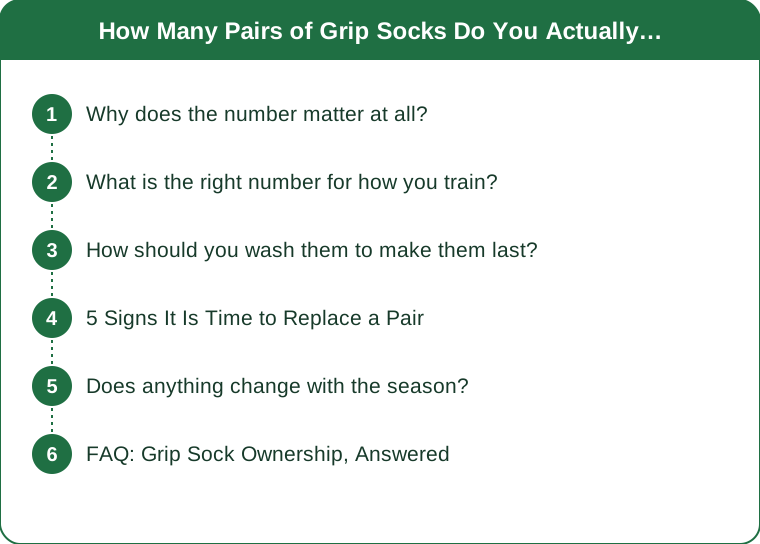
Why does the number matter at all?
Because grip socks fail from washing, not from wearing.
The grip is silicone or rubber printed onto the sock. It degrades from heat, detergent, and fabric softener - not primarily from friction against a floor. A grip sock worn hard for an hour and washed correctly outlasts one worn gently and tumble dried, every time.
So the maths is not what you would expect. Owning six pairs instead of three does not just mean more socks - it means each pair goes through half as many wash cycles for the same number of sessions. The set lasts more than twice as long, not twice as long.
The compression side matters too. The elastic in a sock needs time to recover its shape. A sock worn and washed on consecutive days stretches out faster than the same sock rested between wears. This is the same principle as rotating shoes.
And the practical one: if you own exactly as many pairs as sessions per week, one missed laundry day means training barefoot or in the studio’s spare pair. The buffer is the point.
A reasonable rule of thumb: a well-cared-for pair gives 50-70 sessions before the grip is noticeably reduced. A badly washed pair gives 20.
What is the right number for how you train?
By frequency, assuming a normal weekly laundry cycle.
Once or twice a week: four pairs. Enough to never be caught out, and each pair is washed roughly every other week.
Three times a week: five pairs. The most common case, and five is genuinely the sweet spot for most people.
Four to five times a week: six or seven pairs. At this frequency you are washing more often anyway, so the buffer needs to be bigger.
Daily practice or teaching: eight to ten. Instructors go through them fastest, both from volume and from demonstrating on studio floors that are harder on grip than mats.
If you do more than one discipline, add one. Reformer pilates, barre, and yoga each want slightly different sock types - full-sole grip for reformer, toe socks for anything with toe spread, lighter grip for yoga - and mixing them means each set gets used less.
Adjust for how you wash. If you wash after every session, err upward. If you can hand wash and air dry, you can get away with fewer because each pair lasts much longer.
How should you wash them to make them last?
Five rules, and the first two do most of the work.
1. Cold water, gentle cycle. Heat is what kills silicone grip. A 30C wash instead of a 40C one meaningfully extends grip life.
2. Never tumble dry. The single biggest killer. Dryer heat degrades the grip material rapidly and can melt it outright. Air dry, grip side out, away from a radiator.
3. No fabric softener. It coats fibres with a film, and that film is exactly what stops grip from gripping. This is the most common cause of grip socks that stop working with no visible damage.
4. Inside a mesh bag. Stops them stretching, stops them snagging on zips, and stops them disappearing. It also stops the grip dots rubbing against other garments in the drum.
5. Turn them inside out. Protects the grip surface from abrasion in the wash and gets the sweaty side properly clean, which is the side that actually smells.
On washing frequency: every wear, ideally. Sweat degrades elastic and grows bacteria, and studio floors are not clean. If you genuinely cannot wash after every session, air them out fully rather than leaving them in a bag - the bag is where socks die.

5 Signs It Is Time to Replace a Pair
1. The grip feels slick on a familiar surface. If you are sliding on the same reformer or the same studio floor where you never used to, the grip has worn or been coated by softener. Try one wash without any detergent additives first - sometimes it comes back.
2. Visible smoothing or flaking on the grip. Look at the ball of the foot and the heel. Grip wears from the outside in, so smoothing at the edges of the pattern is the early sign.
3. The sock slides on your foot. Heel slipping inside the sock is an elastic failure, and it is more dangerous than grip failure - a sock that rotates on your foot puts the grip in the wrong place entirely.
4. Persistent odour after washing. Bacteria that survive a wash have colonised the fibres. This is a hygiene issue, not just an unpleasant one, and it does not resolve.
5. Thinning at the ball or the big toe. These are the two highest-load points. A thin patch becomes a hole in about two more sessions, and a hole at the ball of the foot is exactly where you need grip most.
The buying pattern that follows from this: replace one or two pairs at a time rather than the whole set. Staggered replacement means you always have some pairs with full grip, and it spreads the cost.
Does anything change with the season?
Two things, and they both start about now.
Studios get colder and grip changes. As heating comes on and studio floors cool, grip socks feel different - often slippier in the first ten minutes before your feet warm the material. Silicone grip is temperature sensitive, and cold silicone is harder and less tacky.
The fix is a proper warm-up rather than a new sock. Feet that are warm inside a warm sock grip properly. Arriving with cold feet from a cold walk is the actual cause of most first-ten-minutes slipping in autumn.
Drying takes much longer. In summer a hand-washed pair dries overnight; in autumn on a rack in a cool room it can take two days. This alone is an argument for owning an extra pair or two going into the colder months.
And attendance goes up. Most studios see numbers rise sharply from September as outdoor training moves indoors. If you are about to train more often, buy the extra pairs now - and buy them before the seasonal restock prices rather than in January.
A note on thicker socks: some people switch to a warmer, thicker grip sock in winter. They grip the same but change the feel on a reformer footbar noticeably, so if you do switch, expect a session of adjustment.
FAQ: Grip Sock Ownership, Answered
Are expensive grip socks worth it?
Mid-range usually is - better elastic and better grip printing. The very expensive ones are mostly paying for design. Where price genuinely matters is fit, and that is worth spending on if you have wide feet or long toes.
Can I wear the same pair twice between washes?
For a light session, once. Air them out fully in between. For anything sweaty, no - the elastic and the smell both suffer.
Should all my pairs be the same?
Having them identical makes pairing them after laundry trivial, which sounds trivial and genuinely is not. One style, several colours is the practical answer.
Do grip socks work on carpet or wooden floors at home?
Wood and tile yes, carpet no - the grip needs a hard surface to work against. On carpet the sock just slides on the pile.
How do I stop losing one of a pair?
Mesh laundry bag, always. The overwhelming majority of lost socks are lost in the machine, not at the studio.
Is it worth buying multipacks?
Usually yes for the buffer pairs, if the fit works for you. Buy one pair first to test the fit, then the multipack.
TL;DR:
- The formula is weekly sessions plus two. Three sessions a week means five pairs.
- Grip dies from washing, not from wearing - so more pairs means fewer washes each, and the whole set lasts disproportionately longer.
- Cold wash, no tumble dryer, no fabric softener, mesh bag, inside out. Softener is the invisible grip killer.
- Replace when the grip feels slick, the pattern smooths, the heel slips, or odour survives a wash.
- Replace one or two pairs at a time, not the whole set.
- Colder studios mean slippier first minutes and much slower drying - buy the extra pair before the season, not during.
It is a small purchase decision that people get wrong in a consistent direction: too few pairs, worn too hard, washed too hot. Fixing the laundry habit is worth more than any brand upgrade.
Keep Reading
This article is for general informational and styling purposes only. Fit, sizing, and product availability may vary.