Why Grip Socks Feel Slippier When the Studio Gets Cold
Quick Answer: The silicone or rubber grips on the sole are elastomers, and elastomers get harder and less tacky as temperature falls - so the same sock genuinely grips less on a cold floor. Add the dust and residue that accumulate on studio floors and inside sock grips over time, and a pair that felt secure in summer can feel unreliable in autumn. Warming up on the mat, washing the socks correctly, and replacing them on a realistic schedule fixes most of it.
Same socks, same reformer, same studio - and in October your foot creeps on the footbar in a way it never did in July. It is a real change, and it has more to do with material science than with your technique.

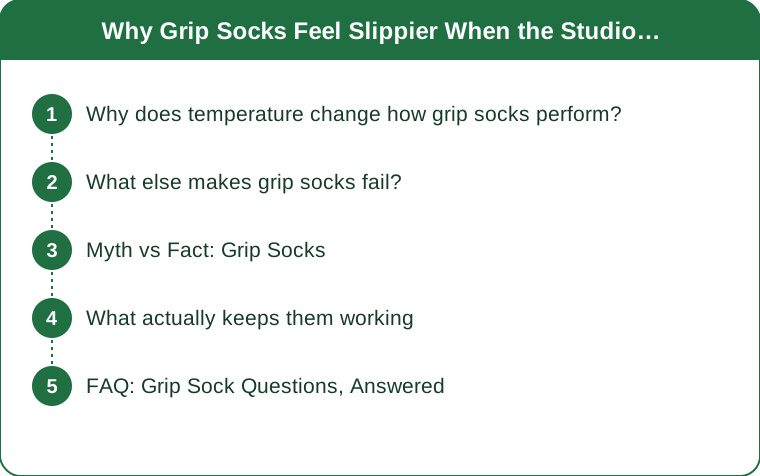
Why does temperature change how grip socks perform?
Because of how the gripping material behaves.
The grips are elastomers - silicone or rubber compounds - and elastomers are strongly temperature-dependent. As they cool, they become stiffer and less able to deform into the microscopic texture of the surface they are on. Grip depends on that deformation, so cooler means less grip.
Studio floors get genuinely cold. A wooden or vinyl floor in an unheated or newly heated room can sit well below room air temperature, particularly on a ground floor or over an unheated space. Your socks are in contact with that floor, not with the air.
Reformer and equipment surfaces cool too. Metal footbars and equipment frames reach and hold ambient temperature efficiently, and a cold footbar is measurably slippier than a warm one.
Humidity plays a part as well. Very dry air affects static behaviour and the way dust sits on surfaces, and heated autumn studios are usually drier than summer ones.
The effect is real but not enormous, which is why it produces the specific experience of socks that are mostly fine and occasionally let go. That inconsistency is more unsettling than an outright failure would be.
And it warms up during class. Grip usually improves through a session as your feet, the equipment, and the room all warm. If your socks feel unreliable in the first ten minutes and fine afterwards, temperature is almost certainly the explanation.
What else makes grip socks fail?
Several things, and most of them are more fixable than the temperature.
Residue on the grips is the biggest one. Silicone grips pick up dust, skin oils, floor cleaner residue, and lint, and once the grip surface is coated it cannot make direct contact with the floor. This builds gradually, which is why people experience it as socks that slowly stopped working.
Fabric softener is the specific villain. Softeners coat fibres and grips with a lubricating film, and using them on grip socks reliably ruins the grip - sometimes permanently. This is the single most common cause of grip socks that failed early.
High heat damages the grips. Tumble drying and hot washes degrade silicone and rubber, causing cracking, hardening, and eventually peeling. Grip socks should be washed cool and air dried.
Physical wear is real and it has a lifespan. Grips thin, crack, and detach with use. A pair worn several times a week will visibly degrade over months, and once the pattern is worn smooth in the high-pressure areas - the ball of the foot and the heel - the sock is done regardless of how the rest looks.
Floor condition matters as much as sock condition. A studio floor with cleaner residue, dust, or polish behaves differently from a clean matte one. If everyone in the class is sliding, it is the floor.
And fit affects grip more than people assume. A sock that is loose lets the foot move inside it, so the grip pattern is in the right place on the floor but the wrong place under your foot. That feels exactly like slipping.

Myth vs Fact: Grip Socks
Myth: Grip socks last until they get holes. Fact: The grips wear out long before the fabric does. Once the silicone pattern is smooth or cracked over the ball of the foot and heel, the sock has stopped doing its job even though it looks entirely wearable. That is what to inspect.
Myth: More grip dots means better grip. Fact: Coverage pattern matters more than dot count. Grip where you need it - across the ball of the foot, the toes, and the heel - matters more than a dense pattern in the arch, which barely touches anything. Full-sole coverage is generally more reliable than scattered dots.
Myth: Washing them ruins the grip. Fact: Washing them incorrectly ruins the grip. Cool wash, no fabric softener, no tumble dryer, inside out if the fabric is delicate - done that way, washing actually preserves grip by removing the oils and residue that reduce it. Unwashed socks lose grip faster than washed ones.
Myth: Slipping means you need better socks. Fact: It often means the floor needs cleaning, the socks need washing, or the room is cold. Buying a new pair when the current ones are coated in residue solves the problem temporarily and then it returns, because the cause was never the socks.
Myth: Grip socks are just a hygiene requirement studios invented. Fact: Hygiene is part of it, but there is a genuine safety and performance function - stable foot contact on a moving reformer carriage or a smooth floor changes what you can do safely. Barefoot grips well on many surfaces but not on equipment upholstery.
What actually keeps them working
A short list that extends their life considerably.
Wash them every few wears, cool, no softener, air dry. This is the whole maintenance regime and it matters more than anything else. Never tumble dry.
Wipe the grips before class if they feel dull. A damp cloth over the sole removes surface dust and restores a surprising amount of grip immediately. This is the fastest fix available and almost nobody does it.
Warm your feet before you need grip. A few minutes of walking, foot articulation, and light movement warms both feet and socks, and it doubles as a sensible warm-up. Arriving five minutes early rather than exactly on time is a genuine grip strategy in autumn.
Check the fit properly. Snug, with the grip pattern sitting where your foot actually loads. A sock that has stretched with age moves the pattern out of position.
Own two or three pairs and rotate. Grips recover from a rest, and rotating spreads wear. It also means you always have a clean pair, which is the practical reason people slide - they wore the same pair four times.
Replace on a realistic schedule. For regular practice, expect a few months from a pair. Inspect the ball of the foot and heel; smooth or cracked means replace.
Ask the studio about the floor. If several people are slipping, floor cleaner residue is a common cause, and studios generally want to know. It is not a complaint, it is useful information.
And if slipping persists across new socks, clean floors, and a warm room, look at foot pressure distribution - loading through the outside edge or gripping with the toes reduces contact area substantially, and that is a technique conversation with your instructor rather than a product one.
FAQ: Grip Sock Questions, Answered
Why do my grip socks slip more in winter?
The silicone grips are elastomers, which get stiffer and less tacky as they cool, so they deform less into the floor surface and grip less. Studio floors and metal equipment hold cold efficiently. Grip usually improves through a session as everything warms up, which is a good diagnostic sign.
How often should I wash grip socks?
Every few wears. Skin oils and dust coat the grips and reduce their effectiveness, so washing actually preserves grip rather than damaging it - provided you wash cool, skip fabric softener entirely, and air dry rather than tumble dry.
Does fabric softener really ruin grip socks?
Yes, and it is the most common cause of grip socks that stop working early. Softener leaves a lubricating film on both the fabric and the silicone grips, which is precisely the opposite of what you want. The damage can be partly reversible with several plain washes, but often is not.
How long do grip socks last?
For a few sessions a week, typically a few months before the grips wear smooth in the high-pressure areas. Inspect the ball of the foot and heel rather than looking for holes - the fabric usually outlasts the grip by a long margin, which is why worn-out socks look perfectly fine.
Why is everyone in my class slipping, not just me?
Almost certainly the floor - residue from floor cleaner, polish, or accumulated dust changes the surface for everyone. Studios generally want to hear about it, since it is both a class-quality and a safety matter, and it is usually resolved with a different cleaning product.
TL;DR:
- Silicone grips are elastomers: they stiffen as they cool and genuinely grip less on a cold floor.
- Grip usually improves through a session as feet, floor, and equipment warm - a useful diagnostic.
- Residue is the bigger long-term cause; wipe the grips before class and wash cool without softener.
- Fabric softener and tumble drying kill grip socks faster than anything else.
- Inspect the ball and heel for smooth or cracked grips, not the fabric for holes.
If everyone in the room is sliding, it is the floor. If it is only the first ten minutes, it is the temperature.
Keep Reading
This article is for general informational and styling purposes only. Fit, sizing, and product availability may vary.